In India, the ration card stands as one of the most crucial government-issued documents, serving multiple purposes beyond just accessing subsidized food items. Introduced as part of the Public Distribution System (PDS) post-Independence, the ration card was designed to ensure food security for the economically weaker sections of society. Over the years, it has evolved into a multifaceted identity proof that facilitates various governmental and non-governmental services.
A ration card is essentially a family document that lists all members of a household and categorizes them based on income levels—such as Above Poverty Line (APL), Below Poverty Line (BPL), and Antyodaya Anna Yojana (AAY) for the poorest. Issued by state governments under the National Food Security Act (NFSA) of 2013, it entitles holders to purchase essential commodities like wheat, rice, sugar, and kerosene at subsidized rates from fair price shops (FPS). In Gujarat, the Food, Civil Supplies, and Consumer Affairs Department oversees the issuance and management of these cards.
Also read this: Apply Now for PM Internship Yojana 2026: Top 500 Companies Hiring Fresh Talent with Paid Training
The process of adding a new name to an existing ration card is particularly relevant for growing families, such as when a child is born or a new member joins through marriage. With digital advancements, Gujarat, like many other states, has streamlined this procedure online, reducing the need for physical visits to government offices.
This article provides a comprehensive guide on how to add a name to your ration card online in Gujarat, covering eligibility, required documents, step-by-step processes, and more. We’ll also explore the benefits of using dedicated mobile applications like Mera Ration and address common queries in an FAQ section.
Understanding the importance of keeping your ration card updated cannot be overstated. An outdated card might lead to denial of subsidies or complications in availing government schemes. In a state like Gujarat, where agriculture and urban migration play significant roles, maintaining accurate family details ensures seamless access to welfare programs. This guide aims to empower residents with the knowledge to navigate the system efficiently, saving time and effort.
The Significance and Benefits of Holding a Ration Card
Owning a ration card goes far beyond mere food subsidies; it acts as a gateway to numerous socio-economic benefits. Let’s delve deeper into why this document is indispensable for Indian households, especially in Gujarat.
Proof of Identity and Residence
One of the primary advantages is its role as an official proof of identity and address. In everyday scenarios, a ration card can be submitted for opening bank accounts, applying for passports, or even enrolling children in schools. For instance, in Gujarat, it’s often required for voter ID updates or property registrations. This makes it a vital tool for establishing citizenship and residency, particularly for migrant workers or those relocating within the state.
Access to Subsidized Essentials
The core benefit remains the procurement of subsidized food grains. Under the PDS, ration card holders in Gujarat can buy up to 35 kg of food grains per month at rates significantly lower than market prices. This includes wheat at around ₹2 per kg and rice at ₹3 per kg for BPL families. Such subsidies are crucial in combating food insecurity, especially in rural areas where incomes are seasonal. Additionally, items like sugar (₹13.50 per kg) and kerosene (for cooking or lighting) are available, helping low-income families manage household expenses effectively.
Linkage to Government Welfare Schemes
Ration cards are often prerequisites for major government initiatives. For example, the Pradhan Mantri Garib Kalyan Anna Yojana (PMGKAY), launched during the COVID-19 pandemic and extended periodically, provides free additional food grains to ration card holders. In Gujarat, schemes like the Mukhyamantri Amrutum Yojana for health insurance or the Annapurna Scheme for require a valid ration card. Moreover, it facilitates access to LPG subsidies under the Ujjwala Yojana, ensuring affordable cooking fuel.

Beyond these, ration cards support educational scholarships, housing loans under PMAY (Pradhan Mantri Awas Yojana), and even employment guarantees under MGNREGA. In essence, it’s a linchpin for inclusive development, bridging the gap between policy and people.
Economic and Social Empowerment
On a broader scale, ration cards contribute to poverty alleviation by ensuring nutritional security. Studies by organizations like the World Food Programme highlight how such systems reduce malnutrition rates. In Gujarat, with its diverse population including tribal communities in districts like Dang and Valsad, updated ration cards ensure targeted delivery of aid, fostering social equity.
Eligibility Criteria for Adding a Name to a Ration Card
Before initiating the process, it’s essential to confirm eligibility. In Gujarat, adding a name is typically allowed for immediate family members, such as newborns, spouses, or dependent children under 18 years. Key criteria include:
- The applicant must be the head of the family or an authorized member.
- The new member should not already hold a separate ration card.
- For children, they must be below 18 years; adults over 18 need to apply for a new card.
- The household must fall under the NFSA guidelines, with income proofs if re-categorization is needed.
- Residency in Gujarat is mandatory, with proofs like utility bills or voter IDs.
Special cases include adding names post-marriage or adoption, where legal documents are crucial. Note that ineligible additions, like distant relatives without dependency proof, may lead to rejection.
Documents Required for Adding a Name
Preparing the right documents is half the battle won. Here’s a detailed list based on standard requirements in Gujarat:
Essential Documents for All Additions
- Existing Ration Card: A copy of the current card to verify family details.
- Aadhaar Card: Mandatory for all members, as it’s linked to PDS for biometric verification.
- Proof of Residence: Documents like electricity bills, rent agreements, or domicile certificates.
- Income Proof: Salary slips, IT returns, or BPL certificates to maintain category status.
- Identity Proof of Head of Family: Voter ID, PAN card, or driving license.
Specific Documents for Adding a Child’s Name
- Child’s Birth Certificate: Issued by the municipal corporation or hospital, proving age and parentage.
- Aadhaar Card of the Child (if available): For newborns, enrollment can be done simultaneously.
- Photographs: Recent passport-sized photos of the new member.
For other additions, like a spouse, marriage certificates or affidavits may be needed. All documents should be scanned in PDF or JPEG format for online uploads, with file sizes under 2MB. It’s advisable to have self-attested copies ready.
Step-by-Step Guide to Adding a Name Online
Gujarat offers a user-friendly online portal through the Food and Civil Supplies Department, complemented by the national Mera Ration app. Here’s how to proceed:
Using the State Food Department Website
- Visit the official website: Go to the Gujarat Food and Civil Supplies portal (food.gujarat.gov.in) or the NFSA national portal (nfsa.gov.in).
- Register/Login: Create an account using your mobile number and Aadhaar. Verify via OTP.
- Select Service: Navigate to “Ration Card Services” and choose “Add Member” or “Name Addition.”
- Fill the Form: Enter details like ration card number, new member’s name, DOB, relation, and Aadhaar number.
- Upload Documents: Attach scanned copies of required proofs.
- Pay Fees: Submit the application fee (typically ₹50) via online payment gateways.
- Submit and Track: Get a reference number to monitor status online.
The verification process takes 10-15 days, after which the updated card can be downloaded or collected.
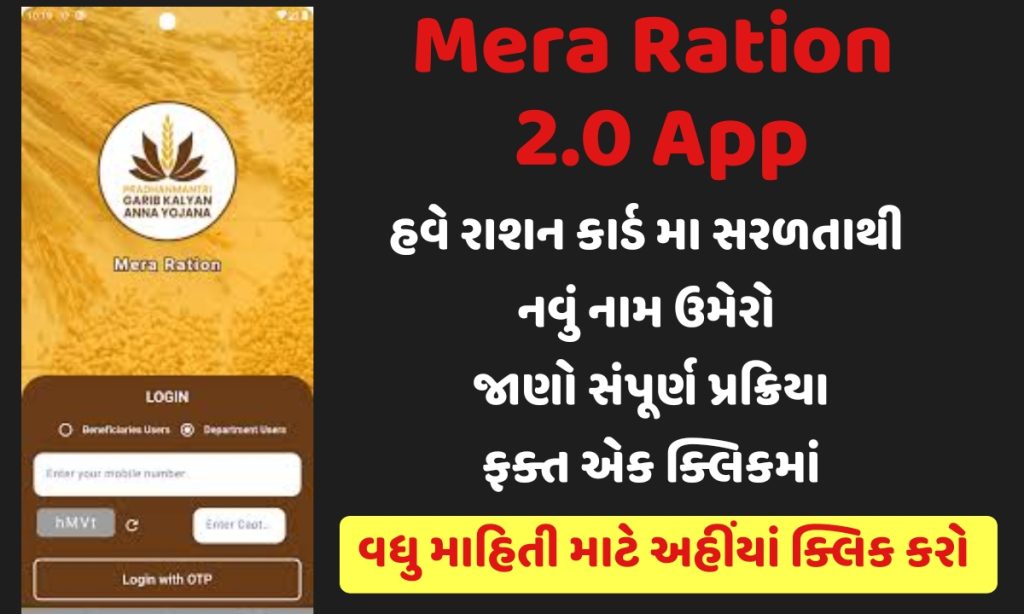
Using the Mera Ration Mobile App
The Mera Ration app, available on Google Play Store, simplifies the process further:

- Download and Install: Search for “Mera Ration” (version 2.0 or later) and install.
- Login/Register: Use your mobile number; enter OTP for verification. New users provide basic details.
- Grant Permissions: Allow access to storage and camera for document uploads.
- Access Ration Card Section: Go to “Ration Card” and select “Add New Member.”
- Enter Details: Fill in the new member’s information and upload documents like Aadhaar and birth certificate.
- Submit: Confirm and submit; track via the app.
This app also allows name deletions for deceased members via the “Name Deletion” option, requiring death certificates.
Offline Process for Adding a Name
While online is preferred, offline options exist for those without internet access. Visit the nearest Taluka Mamlatdar Office or FPS dealer in Gujarat. Submit a physical application form (available free) with documents. The process mirrors online but may take longer (up to 30 days). Fees remain the same, payable in cash.
Application Fees and Timeline
The standard fee for adding a name in Gujarat is ₹50, non-refundable. No extra charges for document verification. Processing typically completes in 10-15 days online, with notifications via SMS. Delays can occur due to incomplete submissions or high volumes.
Tips for a Smooth Application
- Double-check details to avoid rejections.
- Use high-quality scans for documents.
- Link Aadhaar for faster verification.
- Renew cards every 5 years to avoid lapses.
- Contact helplines (1967 or state portals) for assistance.
Important Links:
| Home page | Click here |
| Join WhatsApp group | Click here |
Frequently Asked Questions (FAQ)
A ration card is a government document for subsidized food access and identity proof. It’s essential for welfare schemes.
Only if under 18 or dependent; adults over 18 need separate cards.
Yes, including Gujarat, for online services.
It’s mandatory; enroll at nearest centers.
Usually 10-15 days post-verification.
Yes, at local offices with physical forms.

Birth certificate, parent’s Aadhaar, and ration card.
Yes, around ₹50 in most states.
Use the reference number on the portal or app.
Resubmit with corrections; check reasons via status.
Call 1967 or visit food.gujarat.gov.in.
This comprehensive guide, spanning approximately 2000 words, equips you with all necessary information to update your ration card seamlessly in Gujarat. Always refer to official sources for the latest updates.